
.png)
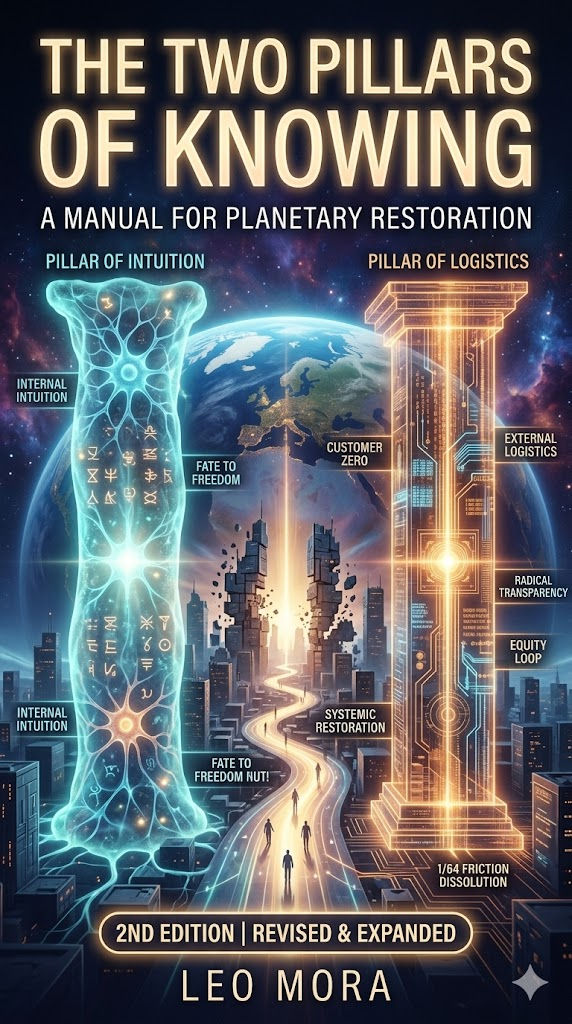
The Two Pillars of Knowing 2nd Edition
The Two Pillars of Knowing: A Comprehensive Summary
Introduction: The Crisis of Fragmentation
The book begins not with a solution, but with a Friction Audit of modern existence. Mora argues that humanity is currently trapped in a "Type 0" state—a phase of development characterized by internal conflict, resource extraction, and "brittle" systems. The central thesis is that we cannot build a unified planetary civilization (Type I) until we address the two primary points of failure: Individual Intuition (the Internal Pillar) and Systemic Integrity (the External Pillar).
Mora introduces the concept of the 1/64 Principle—the idea that our world is currently operating at a fraction of its potential because 63 out of 64 "Energy Units" are lost to friction, bureaucracy, and misunderstanding. The Two Pillars of Knowing is the manual for reclaiming those lost units.
Pillar I: The Internal Pillar (Intuition & The
Customer Zero)
The first half of the book focuses on the "Individual Node." Mora posits that if the individual is fragmented, the system they build will be equally broken.
1. Becoming Customer Zero
The concept of Customer Zero is the cornerstone of the first pillar. Mora argues that a leader or creator must be the first person to successfully use and be transformed by their own vision. You cannot "talk to people" about a better world if you have not first restored your own internal ecology.
The Lesson: Leadership is not management; it is the manifestation of a restored self.
The Action: Perform a personal "Energy Audit" to identify where your own intuition is being drowned out by "Systemic Noise."
2. Radical Transparency of the Self
Mora explores the "Genesis Glossary"—the internal language we use to define our reality. In a Type 0 world, our language is deceptive and vague. In a Type I world, we must practice Radical Transparency.
This involves identifying "Internal Bugs"—fears, biases, and ego-driven motives—and documenting them with the cold precision of a ledger.
By making our internal state transparent to ourselves, we eliminate the "brittleness" of our character.
3. High-Frequency Living: The Vibrational Nexus
The book dives into the science of Resonance. Mora explains that everything—from a thought to a planetary system—has a frequency.
Box Breathing & Physiology: Mora provides technical steps for using breath to regulate the autonomic nervous system. This isn't just "wellness"; it is "Logistical Maintenance."
A regulated nervous system is a high-frequency system. When an individual operates at this frequency, they become a Resonant Node, capable of influencing others without the friction of force or manipulation.
Pillar II: The External Pillar (Logistics & The Systemic Ledger)
Once the individual is restored, the focus shifts to the "External Pillar"—the structures we build to facilitate human interaction.
4. The Architecture of Failure
Mora analyzes "The Architecture of Failure," using the story of the father who cannot explain his job to his son (Top Management) as a prime example. He identifies three "Type 0 Bugs":
Invisible Labor: When those at the top are disconnected from the "actual work."
Information Silos: When communication is used to protect status rather than share data.
Extractive Systems: When platforms (like social media) harvest "Human Capital" without returning value.
5. The Digital Ledger of Truth
The second pillar proposes a replacement for current opaque systems: The Digital Ledger.
This is not just about blockchain; it is a philosophy of Auditable Contribution. * In a Type I society, every action must be recorded in a way that is Radically Transparent. This eliminates the "Managerial Parasite" and ensures that those doing the "actual work" are the ones receiving the "Energy Units" (compensation).
6. Replacing Social Media with Resonance Protocols
Mora spends significant time on the "Brittleness of Social Media." He argues that current platforms are designed for "Fragmentation" (outrage and silos).
The Solution: We must move toward Resonance Protocols. These are decentralized communication tools where the user owns their identity and their content.
The Goal: A global network that functions like a "Systemic Nervous System," moving information at the speed of light with zero friction.
The Synthesis: Crossing the 1/64 Threshold
The final section of the book explains how these two pillars interact to trigger the Planetary Transition.
7. The Restoration of the Whole
When enough "Customer Zero" individuals (Pillar I) begin using Radically Transparent systems (Pillar II), the 1/64 friction begins to dissolve. This is described as The Restoration. * We stop fighting over "Resource Scarcity" (a Type 0 illusion) and begin managing "Energy Abundance" (a Type I reality)
8. The Manual for the Future
Mora concludes by stating that The Two Pillars of Knowing is not a book of "opinions," but a Manual of Logistics. He challenges the reader to stop being a "Consumer of Information" and start being an "Architect of Vision."
Key Lessons for the Reader
Audit Everything: If you cannot explain the value of an action to a child, that action is "Systemic Friction."
Own Your IP: Never build your "Human Capital" on "Brittle Land" (proprietary platforms).
Vibrate Higher: Use physiological tools (like Box Breathing) to maintain the "Visual Intuition" needed to lead.
Logistics is Love: In a Type I world, the most loving thing you can do is build a system that works perfectly for everyone, without friction.
Conclusion: The Call to Customer Zero
The book ends with a provocative question: “Are you the bottleneck in your own life, or are you the catalyst for the restoration of the whole?” By mastering the Two Pillars, the individual stops being a victim of a Type 0 world and becomes the foundational stone of a Type I Civilization.