
.png)
The Pizza Principle: Why Great Projects Require the Right Ingredients

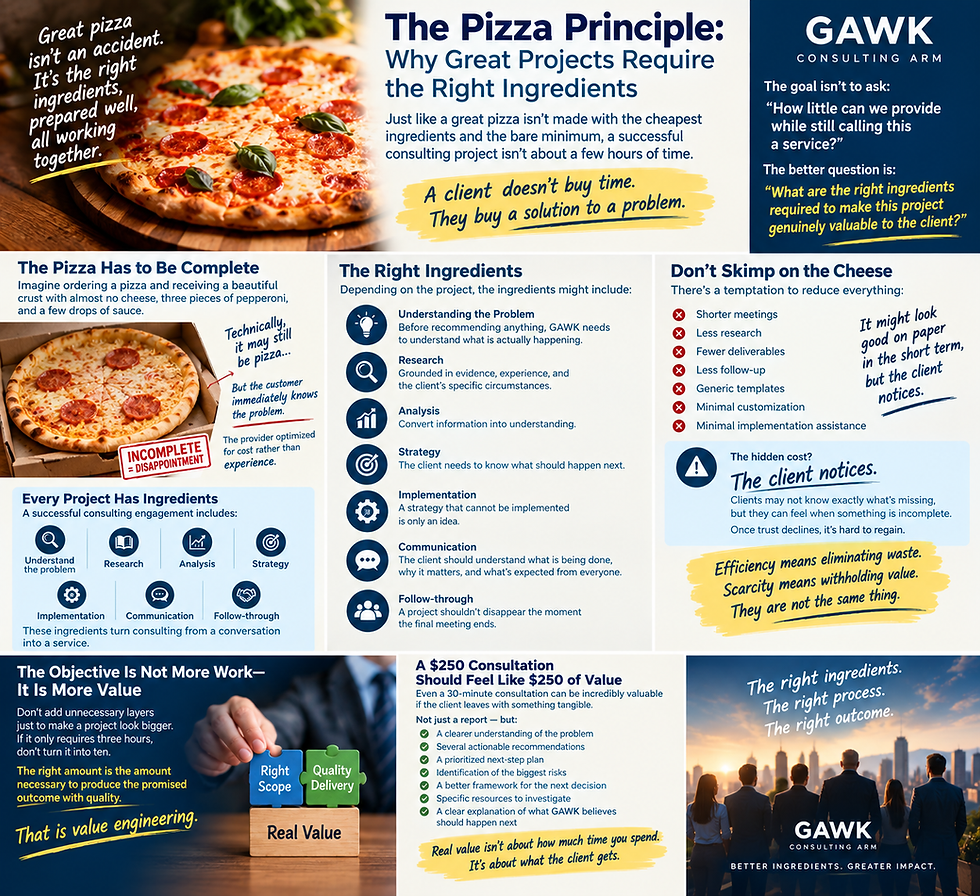
There is a simple way to understand why some consulting projects succeed while others disappoint:
Think about pizza.
A great pizza is not created by throwing together the cheapest ingredients, minimizing every portion, rushing the preparation, and hoping the customer won't notice.
The same is true of a consulting project.
A client doesn't buy a consulting engagement simply to receive a few hours of someone's time. They are buying a solution to a problem.
And if GAWK's Consulting Arm wants to build a lasting reputation, the objective should never be to ask:
“How little can we provide while still calling this a service?”
The better question is:
“What are the right ingredients required to make this project genuinely valuable to the client?”
That difference can determine whether a consulting business becomes a collection of transactions or a trusted organization that clients return to repeatedly.
The Pizza Has to Be Complete
Imagine ordering a pizza and receiving a beautiful crust with almost no cheese, three pieces of pepperoni, and a few drops of sauce.
Technically, it may still be pizza.
But the customer immediately understands the problem.
The provider optimized for cost rather than experience.
Consulting can fall into exactly the same trap.
A consulting firm can technically deliver:
A meeting
A presentation
A report
A few recommendations
A follow-up email
And still leave the client thinking:
“I paid for something, but I don't feel that I received much.”
The problem isn't necessarily the quality of any individual component.
The problem is that the overall meal wasn't complete.
Every Project Has Ingredients
A successful consulting engagement has its own ingredients.
Depending on the project, those ingredients might include:
Understanding the problem.
Before recommending anything, GAWK needs to understand what is actually happening.
Research.
Good recommendations should be grounded in evidence, experience, and the client's specific circumstances.
Analysis.
Information isn't valuable simply because there is a lot of it. It has to be converted into understanding.
Strategy.
The client needs to know what should happen next.
Implementation.
A strategy that cannot be implemented is only an idea.
Communication.
The client should understand what is being done, why it matters, and what is expected from everyone involved.
Follow-through.
A project shouldn't disappear the moment the final meeting ends.
These are the ingredients that turn consulting from a conversation into a service.
Don't Skimp on the Cheese
There is a temptation in consulting to protect margins by reducing everything.
Shorter meetings.
Less research.
Fewer deliverables.
Less follow-up.
Generic templates.
Minimal customization.
Minimal implementation assistance.
This can appear financially attractive in the short term.
But there is a hidden cost:
the client notices.
Clients may not know exactly which ingredient is missing, but they can feel when something is incomplete.
And once a client feels that they received less than they expected, trust begins to decline. And recovering from that decline is difficult.
A consulting company should therefore never confuse efficiency with scarcity.
Efficiency means eliminating waste.
Scarcity means withholding value.
They are not the same thing.
The Objective Is Not More Work—It Is More Value
There is another side to this principle.
Providing a complete service doesn't mean GAWK should perform unnecessary work simply to make a project appear larger.
That would be the equivalent of putting five layers of toppings on a pizza that nobody asked for.
The objective isn't:
“How much can we give?”
The objective is:
“What does the client actually need?”
If a problem requires three hours of work, don't turn it into ten.
If it requires ten, don't pretend three is sufficient.
The right amount is the amount necessary to produce the promised outcome with quality.
That is value engineering.
A $250 Consultation Should Feel Like $250 of Value
If GAWK offers a basic consulting session—for example, a focused 30-minute consultation—the client should leave with something tangible.
Not necessarily a massive report.
But perhaps:
A clearer understanding of the problem
Several actionable recommendations
A prioritized next-step plan
Identification of the biggest risks
A better framework for making the next decision
Specific resources to investigate
A clear explanation of what GAWK believes should happen next
Thirty minutes can be incredibly valuable if those thirty minutes are prepared properly.
The client shouldn't leave thinking:
“I spent thirty minutes talking.”
They should leave thinking:
“I understand my problem better than I did before I walked in.”
That is the difference between selling time and selling value.
The Kitchen Matters Too
A great restaurant doesn't just serve good food.
It has a kitchen.
There is preparation happening before the customer arrives.
The same should happen in consulting.
If GAWK has a consulting appointment at 2:00 PM, the work shouldn't necessarily begin at 2:00 PM.
Preparation should already be underway.
What is the client's problem?
What industry are they in?
What information have they provided?
What questions should be asked?
What frameworks are relevant?
What potential solutions already exist?
What should be avoided?
The customer sees the final pizza.
They don't see everything that happened in the kitchen.
The client sees the consulting session.
They don't necessarily see the preparation behind it.
But they experience the difference.
Don't Serve the Same Pizza to Everyone
One of the easiest ways to damage consulting quality is to treat every client identically.
A generic consulting package may be easy to sell and easy to deliver.
But businesses are different.
People are different.
Problems are different.
Organizations are different.
One company may need organizational restructuring.
Another may need leadership development.
Another may need technology integration.
Another may need strategic clarity.
Another may have a brilliant idea but no implementation framework.
The framework can be consistent.
The solution should be customized.
Think of it as the pizza base.
GAWK can have a standard foundation.
But the ingredients should respond to the customer's actual situation.
Client Satisfaction Is the Final Test
The ultimate test of a consulting project isn't how impressive the internal process looked.
It is what happened for the client.
Did they understand the problem better?
Did they gain clarity?
Did they receive something actionable?
Did they feel heard?
Did the recommendations make sense?
Did the project produce measurable progress?
Did the client feel that GAWK cared about the outcome?
And perhaps the most important question:
Would they call GAWK again?
A satisfied client is more than a successful transaction.
They can become:
A returning client.
A referral.
A case study.
A relationship.
A partner.
An ambassador for the organization.
That is why satisfaction should not be treated as a cosmetic metric.
It is part of the business model.
The Best Pizza Creates a Craving for the Next One
When someone eats an exceptional pizza, they remember it.
They may tell friends.
They may return.
They may try another pizza from the same restaurant.
Consulting works similarly.
If GAWK solves a meaningful problem exceptionally well, the client may eventually bring another problem.
Then another.
The relationship changes from:
“We hired a consultant.”
to:
“GAWK is one of the organizations we trust when we have a difficult problem.”
That is a dramatically more valuable position.
Underpromising and Overdelivering
There is an important balance here.
GAWK should not promise everything.
Overpromising creates unrealistic expectations.
Instead:
Define the service clearly.
Price it honestly.
Explain what is included.
Deliver what was promised.
Add value where appropriate.
Communicate when circumstances change.
Never hide missing ingredients.
Trust grows when expectations and reality consistently match.
Don't Confuse Cheap With Competitive
One of the biggest mistakes a consulting organization can make is competing primarily on price.
There will almost always be someone cheaper.
If GAWK tries to win every client by being the cheapest provider, eventually the business becomes trapped in a race toward smaller margins and thinner services.
Instead, the competitive question should be:
“What can GAWK provide that makes the client say, ‘That was worth it’?”
Price matters.
But perceived value matters enormously.
A $250 consultation that saves someone from making a $50,000 mistake can be extraordinarily valuable.
A $5,000 project that produces no meaningful change can be expensive.
The price is only one part of the equation.
The GAWK Consulting Philosophy
This creates a simple philosophy for the GAWK Consulting Arm:
Don't sell slices. Solve problems.
A client isn't looking for another meeting.
They are looking for progress.
Don't count hours. Create value.
Hours are an input.
Results are the reason the client hired you.
Don't minimize ingredients. Eliminate waste.
Use the resources necessary to produce quality without creating unnecessary complexity.
Don't finish when the clock ends. Finish when the promised service is delivered.
The project should have a defined outcome, not merely a defined number of hours.
Don't chase transactions. Build relationships.
A successful consulting engagement should create the possibility of the next relationship.
The GAWK Pizza Test
Before completing any consulting project, GAWK could ask five simple questions:
1. Did we understand the client's real problem?
2. Did we provide the ingredients necessary to address it?
3. Did we communicate clearly throughout the process?
4. Did the client receive something actionable and useful?
5. Would the client honestly say, “That was worth it”?
If the answer to all five is yes, the pizza is probably ready.
If the answer to one is no, something may still be missing.
The Business Is Built on the Last Bite
Ultimately, consulting isn't about how impressive the first conversation sounds.
It is about what remains after the project is finished.
Did the client gain clarity?
Did they gain capability?
Did they avoid mistakes?
Did they move forward?
Did they feel respected?
Did they receive what they paid for?
Did they trust GAWK more at the end than they did at the beginning?
That final feeling is the equivalent of the last bite of the pizza.
The customer knows whether they enjoyed the meal.
And no amount of marketing can permanently compensate for a bad meal.
GAWK therefore has an opportunity to build its Consulting Arm around a simple principle:
Never skimp on the ingredients that create value.
Give the client the right expertise.
The right preparation.
The right analysis.
The right recommendations.
The right communication.
The right follow-through.
And most importantly, the right outcome.
Because the objective isn't simply to deliver a consulting service.
It is to leave the client satisfied enough to say:
“They understood us. They helped us. They delivered. And when we have another difficult problem, we're calling GAWK.”
That is how a consulting arm becomes more than a business.
It becomes a trusted kitchen for solving difficult problems.
Leonardo Mora
CEO of Vision
GAWK Corporation


Comments