
.png)
GAWK Philosophy: The 20-Second Hug

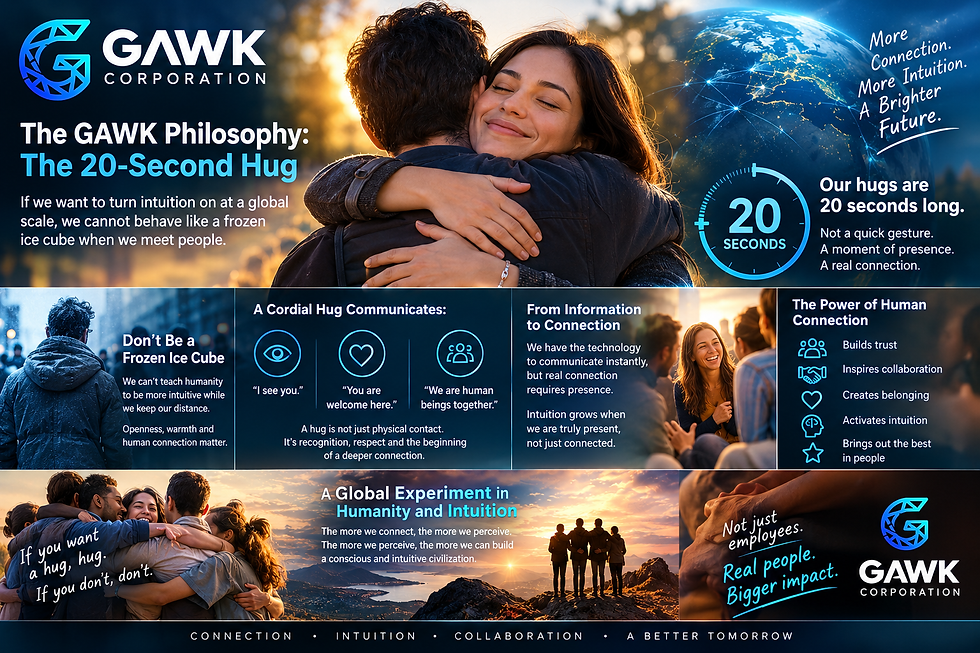
GAWK believes that if we want to help humanity turn intuition back on at a global scale, we internally cannot behave like frozen ice cubes when we meet one another.
Human beings are not machines exchanging information. We are biological, emotional, intuitive beings constantly communicating through facial expressions, body language, tone, proximity, energy, attention, and touch.
Yet modern society has increasingly trained us to create distance.
We shake hands quickly. We exchange names. We ask, “What do you do?” We talk about business. We look at our phones. We move on.
And sometimes we barely look at the human being standing in front of us.
GAWK wants to challenge that culture.
The Philosophy Is Simple: If You Want a Hug, You Get a Hug
At GAWK, we believe in a simple principle:
If two people genuinely want to hug, they should be able to hug.
Not because a hug is merely a social courtesy.
Because human connection matters.
A cordial hug can communicate something that thousands of words cannot:
“I see you.”
“I recognize you.”
“You are welcome here.”
“We are human beings together.”
The key word is consent.
A hug should never be forced, demanded, or imposed. Some people do not want physical contact, and that choice deserves complete respect.
But when two people want the connection, there should be no reason to make human warmth feel strange, suspicious, or inappropriate.
Why Twenty Seconds?
GAWK's tradition is simple:
Our hugs are approximately 20 seconds long.
That is considerably longer than the conventional social hug.
And that is precisely the point.
A quick hug can be almost automatic.
A twenty-second hug requires something different:
Presence.
You cannot easily hug someone for twenty seconds while simultaneously pretending you are somewhere else.
You have to slow down.
You have to breathe.
You have to become aware of another human being.
For those twenty seconds, the meeting stops being transactional.
It becomes human.
From Information to Connection
Our civilization has become extraordinarily good at transmitting information.
We have computers.
Artificial intelligence.
Instant messaging.
Video calls.
Global telecommunications.
We can communicate with someone on the other side of the planet in milliseconds.
But communication is not necessarily connection.
We can have thousands of digital contacts and still experience profound human distance.
This is where GAWK's philosophy of intuition becomes important.
If intuition involves recognizing signals beyond explicit words, then creating environments where people are actually present with one another becomes valuable.
A person can say:
“I'm fine.”
while their face, posture, voice, and behavior communicate something completely different.
Intuition begins when we learn to notice the difference.
The Frozen Ice Cube Problem
Imagine walking through the world as an emotional ice cube.
You don't look at people.
You don't smile.
You don't acknowledge strangers.
You avoid physical contact.
You protect yourself from every possible interaction.
You become professionally polite but emotionally inaccessible.
You may be physically surrounded by millions of people while maintaining an invisible wall around yourself.
That may protect you from some uncomfortable interactions.
But it also blocks something else:
human signal.
If GAWK wants to promote a civilization capable of deeper intuitive awareness, then we have to practice openness ourselves.
We cannot teach humanity to become more intuitive while behaving as though every other human being is a potential threat.
Intuition Requires Openness
Intuition does not mean believing everything you feel.
It does not mean abandoning rationality.
It does not mean assuming that every sensation is a supernatural message.
Instead, GAWK's broader philosophy can treat intuition as the development of sensitivity to information that is often overlooked.
That requires observation.
Attention.
Presence.
Listening.
Emotional awareness.
And openness to other human beings.
The more disconnected we become from one another, the fewer signals we consciously perceive.
The more present we become, the more information becomes available.
Intuition needs an open receiver.
The Hug as a Symbol
The twenty-second hug is therefore bigger than the hug itself.
It represents a philosophy.
It says:
Slow down.
Be present.
Look at the person.
Feel the moment.
Allow connection.
Do not be afraid of being human.
The hug becomes a small rebellion against a civilization increasingly optimized for speed.
We don't always need another transaction.
Sometimes we need another human being.
A Different Corporate Culture
Imagine entering a GAWK environment where the first question isn't necessarily:
“What can you do for us?”
But:
“Who are you?”
Where people can talk about their passions.
Where ideas are welcomed.
Where curiosity is encouraged.
Where people can disagree without becoming enemies.
Where collaboration is more important than hierarchy.
And where, when two people genuinely want to embrace, they don't feel compelled to turn human warmth into something uncomfortable.
That culture could influence how people work together.
Because people who feel recognized tend to interact differently from people who feel like interchangeable resources.
The Global Intuition Experiment
GAWK's larger ambition is not to create a company where everybody hugs.
The hug is only the symbol.
The deeper objective is to ask a much larger question:
What happens if humanity deliberately becomes more attentive to its intuitive, emotional, and interpersonal signals?
What happens when millions of people become better observers?
Better listeners?
More present?
More capable of recognizing emotional signals?
More comfortable with genuine human connection?
More willing to slow down long enough to actually encounter another person?
Perhaps nothing extraordinary happens.
Or perhaps something important begins.
We don't know until we practice it.
And that is the essence of experimentation.
The Rule: Never Force Connection
There is one principle that must remain absolute:
Human connection must remain voluntary.
The GAWK philosophy cannot become:
“You have to hug.”
That would contradict the philosophy itself.
The invitation is:
If you want to hug, hug.
If you don't, don't.
If someone extends their hand, shake it.
If someone prefers a smile, give them a smile.
If someone wants distance, respect their distance.
The objective isn't physical contact.
The objective is authentic connection.
From Frozen Ice Cubes to Living Humans
Perhaps the greatest problem isn't that people don't hug enough.
Perhaps the problem is that we have forgotten how to meet.
Really meet.
Not employee to employee.
Not customer to salesperson.
Not executive to subordinate.
Not stranger to stranger.
But human being to human being.
GAWK wants to experiment with a different culture.
A culture where warmth is not weakness.
Where openness is not naivety.
Where intuition is not dismissed simply because it cannot always be expressed mathematically.
Where rationality and intuition can coexist.
And where a simple twenty-second hug can remind two people of something civilization sometimes makes us forget:
We are not machines.
We are human beings.
And if we want to awaken humanity's intuitive capacity, perhaps the first step is remarkably simple:
Stop walking through the world like a frozen ice cube.
Look up.
Look at people.
Listen.
Connect.
And when someone wants to give you a hug—and you want one too—
give them twenty seconds.
Leonardo Mora
CEO of Vision
GAWK Corporation


Comments