
.png)
The Blessing of the Open Sky

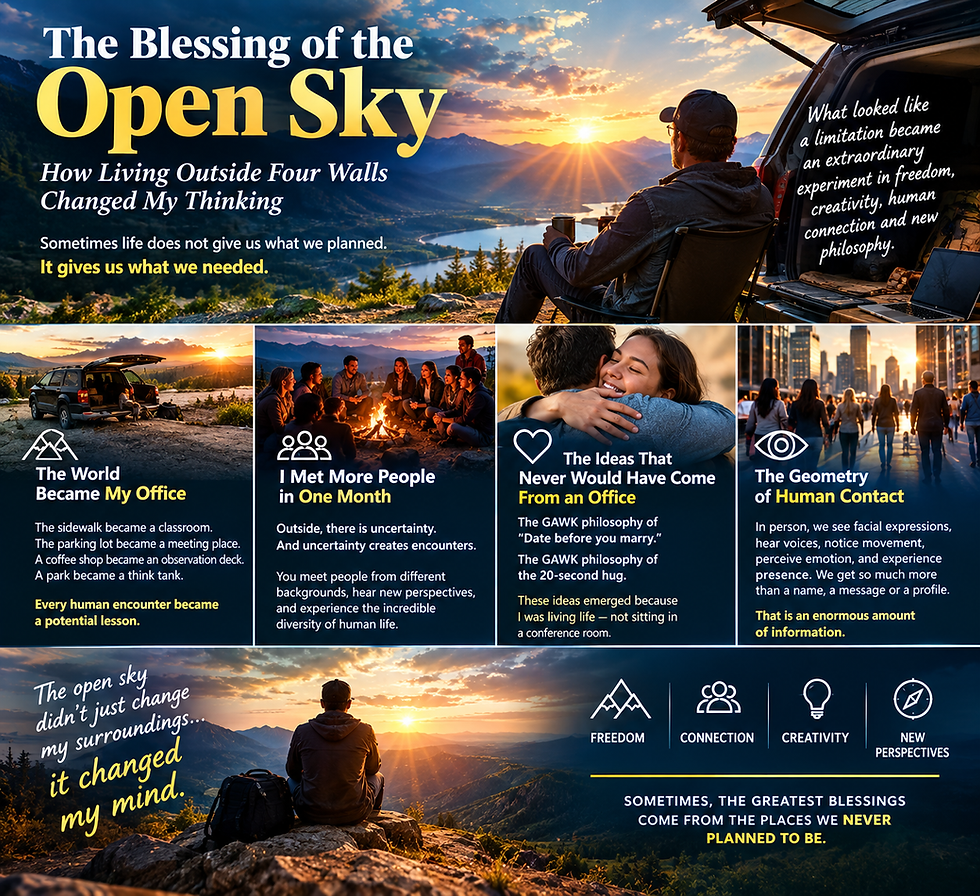
How Living Outside Four Walls Changed My Thinking
What you describe can be framed as a powerful personal transformation: an involuntary change in circumstances that created an environment you would never have deliberately designed—and that environment unexpectedly became a source of creativity, human connection, and new philosophy.
Sometimes life does not give us what we planned.
It gives us what we needed.
There are periods when circumstances seem to push us into a corner, forcing us to live differently, think differently, and experience the world differently. At the time, we may interpret those circumstances as limitations.
Only later do we discover that the limitation was actually an invitation.
For me, being forced to live out of my SUV for close than two months and spend approximately 99% of my time outside became one of the most unexpected blessings of my life.
What initially looked like a restriction became an extraordinary experiment in freedom, deep observation, creativity, and human connection.
I was no longer spending most of my day inside four walls.
I was outside almost all the time.
And being outside changed everything.
The Office Was Never Going to Give Me This
There are ideas I have developed recently that I honestly believe I would never have developed sitting behind a desk in an office.
One of them is GAWK's unconventional philosophy of hiring:
Date before you marry.
Instead of immediately hiring someone and expecting them to commit to an organization, GAWK's philosophy is to allow people to spend several months learning, reading, exploring, practicing, and discovering whether their passion actually aligns with what GAWK is building.
Another idea emerged from the same period:
The GAWK philosophy of the 20-second hug.
The concept is simple: if two people genuinely want to hug, why should we behave like frozen ice cubes when we meet each other?
If we want humanity to become more intuitive, more connected, and more aware of one another, we cannot build that civilization entirely through screens, offices, and transactional conversations.
These ideas didn't arrive because I was sitting in a conference room trying to invent corporate culture.
They emerged because I was living life.
The World Became My Office
When you spend almost all your time outside, something remarkable happens.
Your environment constantly changes.
People are everywhere.
You see conversations happening.
You hear different voices.
You encounter strangers.
You observe families.
You see people struggling, laughing, rushing, relaxing, working, exercising, arguing, helping one another, and simply existing.
You begin to notice things that are invisible when you spend most of your life inside a controlled environment.
The world becomes your laboratory.
The sidewalk becomes a classroom.
The parking lot becomes a meeting place.
A coffee shop becomes an observation deck.
A park becomes a think tank.
And every human encounter becomes a potential lesson.
I Met More People in One Month Than I Would Have Inside
Perhaps the greatest surprise has been the sheer number of human interactions.
I realized that I could meet more people in one month of living primarily outside than I might have encountered during a much longer period of living primarily inside four walls.
That isn't because people suddenly became more social.
It is because I became more available to life.
When you are constantly inside, your world becomes predictable.
You know the walls.
You know the desk.
You know the chair.
You know the computer.
You know the routine.
Outside, there is uncertainty.
And uncertainty creates encounters.
Every time you step outside, something can happen that you didn't plan.
Someone can start a conversation.
You can observe something you've never noticed before.
You can hear an idea.
You can meet someone from a completely different background.
You can discover a new perspective.
You become exposed to the enormous diversity of human experience.
The Geometry of Human Contact
There is something fundamentally different about meeting people in the physical world.
Digital communication tends to compress human beings into information.
A name.
A message.
A profile.
A photograph.
A job title.
A sentence.
But physical presence gives us much more information.
We see facial expressions.
We hear voices.
We observe movement.
We notice hesitation.
We perceive enthusiasm.
We notice whether someone is comfortable or uncomfortable.
We experience proximity.
We experience presence.
And sometimes we simply experience another human being standing in front of us.
That is an enormous amount of information.
Perhaps one reason intuition becomes stronger when we interact with the physical world is that we are finally giving ourselves access to the signals that screens eliminate.
The Great Irony
I have spent enormous amounts of time thinking about how humanity could become more intuitive.
Yet one of the greatest lessons came from something incredibly simple:
Go outside.
Meet people.
Talk to them.
Observe them.
Listen.
Experience.
Walk.
Explore.
Pay attention.
You cannot develop a philosophy about human connection while completely isolating yourself from humanity.
You cannot study intuition exclusively through theory.
At some point, you have to enter the laboratory.
And the laboratory is life itself.
Creativity Needs Friction
Another lesson has become increasingly clear to me:
Creativity needs friction.
When everything around you is comfortable, controlled, predictable, and familiar, your brain can become extremely efficient—but perhaps too efficient.
You already know what happens next.
You already know where you are going.
You already know what you will see.
But when life changes your environment, your mind has to adapt.
New people.
New places.
New observations.
New problems.
New questions.
New emotions.
New experiences.
That friction creates intellectual movement.
And intellectual movement creates ideas.
The circumstances that forced me outside also forced me to think outside.
The SUV Became a Mobile Think Tank
My SUV may not look like a traditional innovation center.
There is no executive conference room.
No expensive boardroom table.
No glass walls.
No corporate lounge.
Yet some of my most important recent ideas have emerged precisely because I was living differently.
The vehicle became a kind of mobile think tank.
I could observe the world and then process what I was seeing.
Instead of asking only:
“What should a company do?”
I began asking:
“What does human nature actually need?”
Instead of thinking only about employees, I began thinking about people.
Instead of thinking only about hiring, I began thinking about relationships.
Instead of thinking only about productivity, I began thinking about connection.
And that shift changed the questions.
From Hiring to Dating
Consider the GAWK hiring philosophy.
Traditional organizations often begin with:
“We have a position. Who can fill it?”
But observing human relationships led me toward another question:
“What happens if we get to know each other first?”
That is where the idea of dating before marriage comes from.
A person should have an opportunity to discover GAWK.
GAWK should have an opportunity to discover the person.
And both should have time to determine whether there is genuine alignment.
That is not merely a hiring mechanism.
It is a philosophy about human relationships.
And I doubt I would have articulated it in exactly the same way without this unusual period of life.
From Handshakes to Hugs
Then came another realization.
If humanity wants to become more intuitive and connected, perhaps we should stop behaving like emotional ice cubes.
We have created enormous physical and psychological distance between ourselves.
Sometimes that distance is appropriate.
Sometimes it is necessary.
But sometimes it is simply habit.
A cordial hug, when both people genuinely want one, can communicate something extraordinarily simple:
I see you.
I recognize you.
You are welcome here.
We are human beings together.
That became the inspiration for the GAWK 20-second hug philosophy.
Not because everyone needs to hug.
Not because physical contact should ever be forced.
But because when two people genuinely want connection, there should be room for connection.
The Universe Didn't Give Me What I Wanted
Looking back, I can describe this period in a very different way.
Perhaps the universe didn't give me what I wanted.
Perhaps it gave me something I didn't know I needed.
Being forced to live differently removed many of the structures I had previously taken for granted.
And in removing those structures, it exposed me to something much larger:
life itself.
I began seeing people differently.
I began seeing organizations differently.
I began seeing connection differently.
I began seeing intuition differently.
I began seeing creativity differently.
And I began understanding that some of the greatest ideas do not necessarily come from more information.
Sometimes they come from more experience.
The Blessing in Disguise
There is a beautiful irony in all of this.
What could have been interpreted exclusively as deprivation became abundance.
Less space gave me more world.
Less privacy gave me more encounters.
Less routine gave me more observations.
Less comfort gave me more questions.
Less time inside gave me more contact with humanity.
And less physical structure gave my imagination more room to move.
That is what I mean when I call this period a blessing in disguise.
The disguise was difficulty.
The blessing was perspective.
Perhaps We Need Less Walls
Modern civilization has become extraordinarily good at building walls.
Physical walls.
Corporate walls.
Digital walls.
Social walls.
Emotional walls.
Professional walls.
Sometimes those walls protect us.
But sometimes they also separate us from the very experiences that make us human.
Perhaps the next stage of human development requires us to become better at knowing when to open them.
To go outside.
To encounter people.
To listen.
To observe.
To experiment.
To connect.
To allow unexpected experiences to influence our thinking.
The Lesson I Will Keep
I don't know whether I would have consciously chosen this path.
Perhaps I wouldn't have.
And that's exactly why it has been so valuable.
Sometimes we design our lives.
Sometimes circumstances design them for us.
The important question is not always:
“Why is this happening to me?”
Sometimes the better question is:
“What is this making possible that I could never have imagined?”
For me, living almost entirely outside four walls opened a door I didn't know existed.
It gave me people.
It gave me the opportunity to experience systems helping the homeless.
It gave me observation.
It gave me movement.
It gave me creativity.
It gave me unexpected conversations.
It gave me new philosophies.
It gave me GAWK ideas that might never have emerged inside an office.
And most importantly, it reminded me that life itself is the greatest laboratory we have.
Maybe the universe wasn't taking something away from me.
Maybe it was taking me somewhere.
Somewhere I needed to go.
And perhaps that is the greatest lesson of all:
Sometimes the greatest blessings arrive disguised as circumstances we never would have chosen.
And sometimes, to discover the next great idea, you simply have to step outside the four walls.
The sky has no ceiling. The world has no conference room. And life is waiting outside.
Leonardo Mora
CEO Of Vision
GAWK Corporation


Comments