
.png)
The GAWK Employment Philosophy

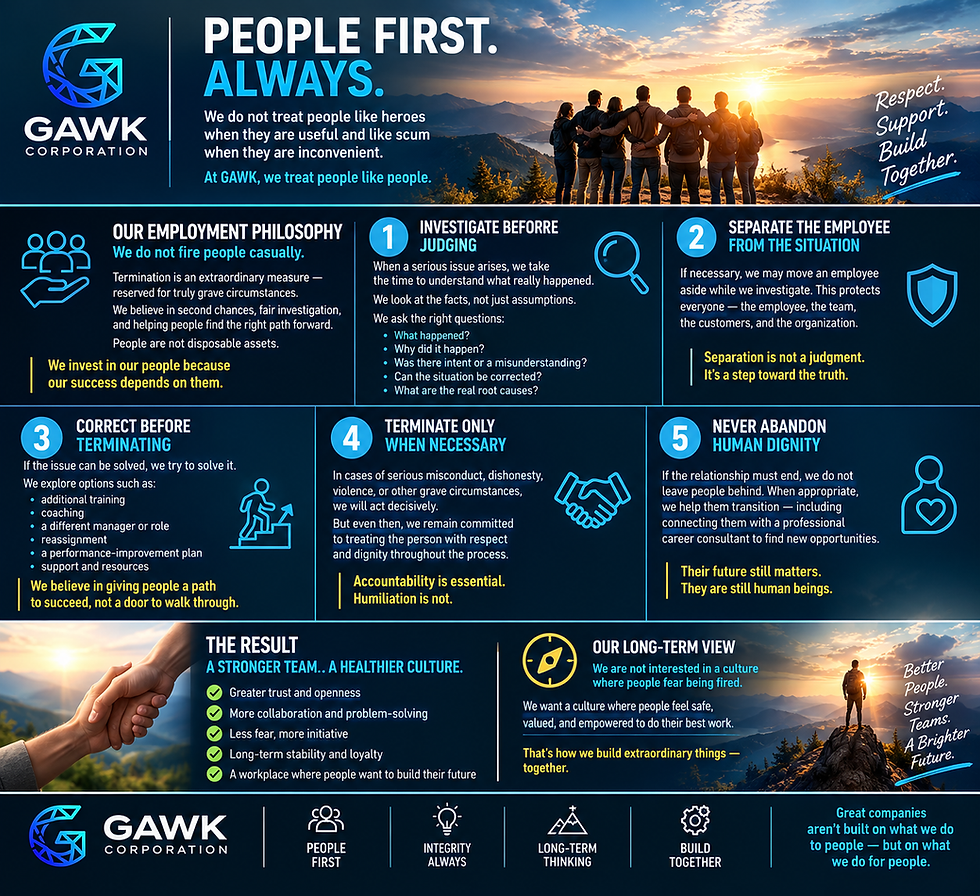
The strongest version of this policy is not simply “GAWK does not fire people.” It is that GAWK believes employment should not be disposable and that termination should be an extraordinary measure—not a routine management tool.
We Do Not Treat People Like Heroes Today and Scum Tomorrow
There is a deeply troubling pattern in modern corporate culture.
An employee performs exceptionally well, works long hours, solves difficult problems, stays late when necessary, helps the company through a crisis, builds relationships with customers, and delivers results.
The company calls that person a hero.
The employee receives praise.
They are told they are essential.
They are recognized for their dedication.
They are encouraged to believe that they are part of something bigger than themselves.
And then, sometimes, something changes.
Revenue declines.
A new manager arrives.
A project disappears.
The organization restructures.
A mistake is made.
A personality conflict develops.
A new technology makes a position less necessary.
Suddenly, the same person who was celebrated yesterday becomes a line item on a spreadsheet.
The language changes.
The relationship changes.
And the employee is told:
“Your employment is terminated effective today.”
GAWK Corporation believes there is a better way.
People Are Not Disposable Assets
GAWK's philosophy is based on a simple principle:
A person does not stop being valuable simply because something went wrong.
Employment is a relationship between human beings and an organization.
People make mistakes.
People have difficult periods.
People misunderstand situations.
People experience personal challenges.
People occasionally fail.
Organizations fail too.
Managers fail.
Systems fail.
Processes fail.
Communication fails.
Technology fails.
A single failure should therefore not automatically transform a valued employee into an enemy.
GAWK seeks to distinguish between a problem that can be solved and conduct that makes continued employment impossible.
That distinction matters.
Termination Should Be the Exception, Not the Default
GAWK's general philosophy is that employees should not be fired except in genuinely grave circumstances.
That does not mean that GAWK ignores misconduct.
It does not mean that poor performance is acceptable indefinitely.
It does not mean that employees are immune from accountability.
And it does not mean that an organization should retain someone indefinitely when the employment relationship has become fundamentally incompatible with the company's responsibilities.
It means something different:
Termination should be considered a last resort.
Before reaching that point, GAWK seeks to understand what actually happened.
Was the employee properly trained?
Were expectations clear?
Was the employee given the resources necessary to succeed?
Was the failure intentional?
Was it an isolated mistake?
Was there a communication breakdown?
Was the employee acting under unreasonable pressure?
Was there a management problem?
Was the system itself defective?
Can the problem be corrected?
Can the employee be reassigned?
Can the employee be coached?
Can the situation be repaired?
Those questions should come before simply asking:
“How quickly can we get rid of this person?”
Moving an Employee Aside Is Not the Same as Firing Them
When a serious situation occurs, GAWK may temporarily remove an employee from the circumstances surrounding the issue while the organization investigates.
This is an important distinction.
The employee has not necessarily been declared guilty.
The employee has not necessarily been terminated.
The organization is creating space for investigation.
That protects everyone.
It protects the company.
It protects customers.
It protects coworkers.
And it protects the employee from being judged before the facts are understood.
The principle is straightforward:
Separate the person from the situation before deciding the future of the person.
An investigation should attempt to establish facts rather than simply validate an assumption.
What happened?
Why did it happen?
Who was involved?
What evidence exists?
What policies apply?
Was there intent?
Was there negligence?
Was there misunderstanding?
What harm occurred?
Can the harm be repaired?
What would have to change for the employee to succeed?
Only after those questions are examined should a serious employment decision be made.
Accountability Without Dehumanization
One of the greatest mistakes in corporate management is believing that there are only two choices:
Keep the employee exactly where they are.
or
Fire the employee.
There is an enormous space between those two options.
An employee might need:
additional training
coaching
a different manager
a different role
reassignment
additional supervision
a performance-improvement process
mediation
time away from the immediate situation
clearer expectations
additional resources
a change in responsibilities
GAWK believes management should explore those possibilities when appropriate.
The goal is not to protect someone from accountability.
The goal is to determine whether accountability and continued employment can coexist.
Often, they can.
A Mistake Does Not Erase a Career
Imagine an employee who has worked for GAWK for eight years.
For eight years, that person contributed knowledge, relationships, ideas, institutional memory, and effort.
Then the employee makes a serious mistake.
Should eight years of contribution suddenly become meaningless?
GAWK's philosophy says:
No.
The mistake must be addressed.
The consequences must be understood.
Corrective action may be necessary.
But the employee's entire history should not automatically disappear.
Human beings are more complicated than a performance score.
A person's value cannot always be calculated from their most recent mistake.
But GAWK Must Also Protect the Organization
Compassion does not mean weakness.
There are circumstances in which an organization must act decisively.
Certain conduct can be so serious that continued employment is no longer appropriate.
Examples could include grave misconduct, serious dishonesty, violence, deliberate actions that create severe harm, major violations of law or company policy, or other circumstances where continued employment presents an unacceptable risk.
In those circumstances, GAWK must protect its people, customers, intellectual property, reputation, and business.
The philosophy is therefore not:
“Nobody can ever be fired.”
It is:
“We do not fire people casually.”
There is a profound difference.
What Happens When the Relationship Simply Cannot Continue?
Sometimes an investigation concludes that the employee should not return to their previous position.
Even then, GAWK's philosophy does not have to become:
“You are no longer our problem.”
If the situation permits and the circumstances warrant it, GAWK can explore alternatives.
That could include reassignment.
It could include a different position.
It could include assistance transitioning outside the organization.
And in particularly difficult circumstances, GAWK can consider engaging a professional career consultant to help the individual identify another employment opportunity where their skills, personality, and experience may be better suited.
This is a fundamentally different philosophy from simply handing someone a termination document and closing the door.
The message becomes:
“This relationship may no longer work in its current form, but your life and your career still matter.”
We Do Not Turn Heroes Into Scum
This is perhaps the most important part of GAWK's philosophy.
Too many organizations operate with a strange psychological switch.
When an employee is useful:
“You are incredible.”
When the employee becomes inconvenient:
“You are a problem.”
When the employee produces results:
“We couldn't have done it without you.”
When something goes wrong:
“We have no further use for you.”
That is not how GAWK wants to treat human beings.
A person should not be treated like a hero one day and like scum the next.
Human dignity should not be conditional upon perfect performance.
People should be treated with respect when they succeed.
They should also be treated with respect when they struggle.
They should be treated with respect when they make mistakes.
And, when separation genuinely becomes necessary, they should be treated with respect during that process as well.
The GAWK Standard: People First, Accountability Always
GAWK's approach can be summarized in five principles:
1. Investigate Before Judging
Serious allegations require facts.
2. Correct Before Terminating
If a problem can reasonably be solved, attempt to solve it.
3. Separate the Employee From the Problem
Temporary removal from a situation can create the space necessary for an objective investigation.
4. Terminate Only When Necessary
Employment termination should generally be reserved for grave circumstances or situations where reasonable alternatives have genuinely failed.
5. Never Abandon Human Dignity
Even when employment ends, the person remains a human being with skills, responsibilities, relationships, and a future.
A Different Kind of Corporate Culture
This philosophy creates an important psychological difference inside an organization.
Employees know that GAWK takes serious problems seriously.
But they also know that one mistake does not necessarily mean the end of their career.
That can create something extremely valuable:
Trust.
When employees believe that management is looking for reasons to help them succeed rather than reasons to eliminate them, they may be more willing to report problems.
They may be more willing to admit mistakes.
They may be more willing to ask for help.
They may be more willing to challenge dangerous decisions.
They may be less likely to hide failures until those failures become catastrophic.
That is not merely compassionate management.
It is risk management.
A culture where employees are terrified of being fired can encourage concealment.
A culture where employees can acknowledge problems encourages correction.
The Organization Has Responsibilities Too
Employment relationships are often described as if only employees have obligations.
Employees must perform.
Employees must follow policies.
Employees must meet expectations.
Employees must be accountable.
All of that is true.
But organizations have obligations too.
Management has a responsibility to create reasonable conditions for success.
Leadership has a responsibility to investigate fairly.
Managers have a responsibility to communicate clearly.
The organization has a responsibility to distinguish mistakes from intentional misconduct.
And leadership has a responsibility to remember that the person sitting across the table is not merely an employee number.
They are a human being.
GAWK's Long-Term View
GAWK is not interested in building a culture where people constantly look over their shoulders wondering:
“Am I going to be fired tomorrow?”
GAWK wants people thinking:
“How can we build something extraordinary together?”
That requires stability.
It requires trust.
It requires accountability.
It requires forgiveness when forgiveness is appropriate.
And it requires the courage to make difficult decisions when forgiveness is no longer sufficient.
The objective is not to eliminate consequences.
The objective is to eliminate casual disposability.
People Are More Than Their Worst Day
Every organization eventually faces difficult personnel decisions.
The question is not whether difficult decisions will occur.
The question is how the organization behaves when they do.
GAWK chooses to begin with investigation rather than condemnation.
With correction rather than immediate termination.
With accountability rather than humiliation.
With alternatives rather than automatic disposal.
And, when separation ultimately becomes necessary, with dignity rather than contempt.
Because a person's employment status may change.
Their position may change.
Their responsibilities may change.
Their relationship with the company may even end.
But none of those things changes one fundamental fact:
They are still a human being.
That is the standard GAWK seeks to establish.
At GAWK, we do not treat people like heroes when they are useful and like scum when they are inconvenient. We treat people like people.
Accountability matters. Performance matters. The mission matters.
But human dignity matters too.
And when there is a choice between throwing a person away and finding a way forward, GAWK will look for the way forward first.
Leonardo Mora
CEO of Vision
GAWK Corporation


Comments