
.png)
The GAWK Philosophy of Experiencing Life


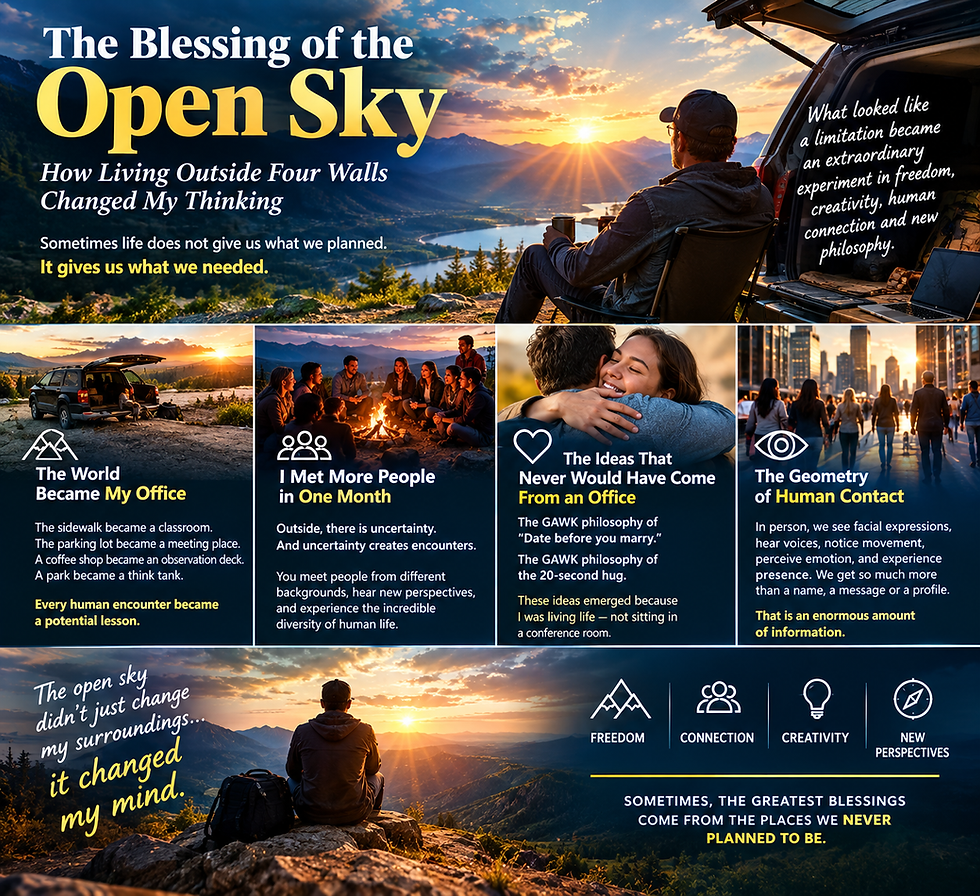
The article below develops the idea as a GAWK workplace philosophy: the office is a tool, not the boundary of an employee's world. It builds directly on the “open sky,” observation, human contact, and creativity themes in your source.
Why Our People Should Not Spend Their Entire Lives Inside Four Walls
There is a simple idea behind the GAWK philosophy of work:
Life does not happen inside four walls.
An office can be useful.
A conference room can be useful.
A desk can be useful.
A computer can be useful.
But none of these things should become the entire environment in which a human being experiences life.
At GAWK, we believe that our people should have room to experience the world around them.
If someone needs to work in an office, good.
If someone wants to work from a coffee shop, good.
If someone needs to meet a customer, collaborator, friend, or potential partner somewhere in the community, good.
If someone needs quiet time to think in a park, library, or another appropriate environment, good.
The objective is not to eliminate the office.
The objective is to eliminate the idea that the office is where life and thinking must always happen.
The World Is a Laboratory
One of the central lessons behind this philosophy is that observation requires exposure to the real world.
When we spend almost all of our time inside controlled environments, our experiences become predictable.
We know the walls.
We know the desk.
We know the computer.
We know the routine.
We know what the next hour is probably going to look like.
But the outside world is different.
There are strangers.
Conversations.
Traffic.
Families.
Businesses.
Children.
Older people.
Customers.
Entrepreneurs.
Artists.
Workers.
Travelers.
People struggling.
People succeeding.
People laughing.
People arguing.
People helping one another.
People doing things we have never considered.
That unpredictability is valuable.
The original open-sky experience behind this philosophy described the world as becoming a laboratory: a sidewalk becoming a classroom, a coffee shop becoming an observation deck, a park becoming a think tank, and human encounters becoming potential lessons.
GAWK can bring that philosophy into the workplace.
We Want Employees to Experience Life
There is an important distinction between working remotely and experiencing the world.
Remote work can sometimes mean moving from an office desk to a desk at home.
The walls have changed.
But the underlying experience may not have changed very much.
GAWK's philosophy goes further.
We want our people to have opportunities to experience environments that stimulate observation, curiosity, creativity, and human connection.
That could mean working from a coffee shop for part of the day.
It could mean walking while thinking.
It could mean taking a meeting somewhere appropriate outside the traditional office.
It could mean spending time in a public environment where different kinds of people are present.
It could mean simply stepping away from the computer and observing the world.
The purpose is not to create another corporate requirement.
It is to create freedom.
Freedom Means Having a World Beyond Work
A company can give an employee a salary.
It can give them a computer.
It can give them an office.
It can give them benefits.
But there is another form of value a company can provide:
the freedom to remain a human being while working.
Employees should not feel that becoming productive means becoming disconnected from life.
Work should exist within life.
It should not consume the entire definition of life.
A person might spend part of the morning in an office, have lunch at a local café, meet someone new, return to the office for a meeting, and spend the afternoon working somewhere else.
There is nothing inherently less professional about that.
If the work gets done, responsibilities are fulfilled, customers are served, and the organization operates effectively, then the physical location should often be secondary.
Observation Is an Organizational Asset
GAWK is interested in knowledge, wisdom, intuition, creativity, and the development of human potential.
Those things cannot always be produced by sitting in front of a spreadsheet.
Sometimes they emerge from observation.
You see something.
You wonder why it happens.
You talk to someone.
You notice a pattern.
You experience a problem.
You hear an unexpected perspective.
You encounter someone whose life is completely different from yours.
And suddenly, an idea appears.
The source article describes this process as a kind of intellectual friction: new people, new places, new observations, new problems, new questions, and new experiences create intellectual movement.
That is precisely the kind of environment in which innovative thinking can emerge.
The Coffee Shop Can Teach You Something
Imagine an employee sitting in a coffee shop working on a GAWK project.
At the next table, two entrepreneurs are discussing a problem.
Behind them, a parent is trying to keep a child entertained.
A customer is frustrated because an order is wrong.
Someone walks in wearing a uniform from a completely different industry.
A musician begins playing outside.
A person is interviewing for a job.
Another person is having a difficult conversation.
None of these people are part of the employee's assignment.
And yet, every one of these observations can potentially teach something about humanity.
How people communicate.
How people buy.
How people react.
How people solve problems.
How people cooperate.
How people disagree.
How people behave under pressure.
How people form relationships.
This is data.
Not spreadsheet data.
Human data.
And human data matters enormously to a company trying to build products, organizations, systems, and ideas for human beings.
We Don't Want Human Beings Becoming Office Furniture
There is a danger in corporate culture when people become defined entirely by their job.
Employee number.
Job title.
Department.
Desk.
Calendar.
Meetings.
Performance review.
Repeat.
That structure can be efficient.
But humans are more complicated than organizational charts.
A GAWK employee is not simply an engineer, designer, manager, salesperson, researcher, or administrator.
They are also a person experiencing a world.
They have curiosity.
Relationships.
Interests.
Ideas.
Memories.
Questions.
Dreams.
Observations.
Experiences.
And those things influence the quality of the person they bring into the organization.
The GAWK Principle: Work Where You Work Best
The philosophy can therefore be stated simply:
If you need the office, use the office.
If you need a conference room, use the conference room.
If you work better from a coffee shop, use the coffee shop when appropriate.
If you need quiet, find quiet.
If collaboration requires physical presence, be physically present.
If a customer needs you somewhere, go there.
The location should serve the work.
The employee should not exist merely to serve the location.
Of course, this philosophy does not eliminate accountability.
Freedom requires responsibility.
Employees still need to meet commitments, protect confidential information, maintain professional standards, communicate effectively, and accomplish their responsibilities.
But accountability does not require unnecessary confinement.
The Unpredictable World Creates Unexpected Connections
One of the greatest benefits of being outside is that you encounter people you didn't plan to meet.
That matters.
A person sitting in an office generally interacts with the people who are already part of the organization's network.
Outside, the network expands.
You encounter people from different industries.
Different generations.
Different economic circumstances.
Different cultures.
Different professions.
Different ways of thinking.
That exposure can challenge assumptions.
It can produce empathy.
It can generate ideas.
And sometimes it can create relationships that would never have existed inside a traditional corporate environment.
The source article describes this as becoming “more available to life.”
That is an important GAWK concept.
A Company Should Not Become a Bubble
Organizations can become bubbles.
Employees talk primarily to employees.
Managers talk primarily to managers.
Executives talk primarily to executives.
Departments communicate primarily within departments.
Eventually, the organization develops its own vocabulary, assumptions, habits, and worldview.
Meanwhile, the outside world continues changing.
Customers are changing.
Technology is changing.
Culture is changing.
People are changing.
A company that rarely encounters the outside world risks developing an increasingly distorted picture of reality.
GAWK's answer is simple:
Go experience reality.
Talk to people.
Observe.
Listen.
Walk.
Explore.
Learn.
Then bring those experiences back into the organization.
The Office Should Be a Base, Not a Prison
There is nothing wrong with an office.
In fact, offices can be extraordinarily valuable.
They provide infrastructure.
They create places for collaboration.
They make spontaneous internal conversations possible.
They can provide laboratories, equipment, meeting spaces, and environments specifically designed for certain kinds of work.
But an office becomes problematic when people begin believing:
“This is where real work happens, and everywhere else is a distraction.”
GAWK challenges that assumption.
Sometimes the most important work happens outside the building.
Sometimes the best idea arrives while walking.
Sometimes a conversation in a coffee shop changes how someone thinks.
Sometimes seeing a customer struggle with something reveals a product opportunity.
Sometimes meeting a stranger creates an entirely new perspective.
Sometimes getting away from the screen is exactly what allows the mind to solve the problem.
From Employee to Human Being
There is a deeper philosophy underneath this policy.
GAWK does not want merely to employ people.
We want people to develop.
We want people to experience.
We want people to learn.
We want people to observe.
We want people to become more aware of humanity.
Our public description of GAWK emphasizes knowledge, wisdom, consciousness, and changing how people interact with one another. (LinkedIn)
A workplace philosophy built around experiencing life naturally follows that mission.
If we want people to understand humanity, they need to experience humanity.
If we want people to understand connection, they need opportunities for connection.
If we want people to develop intuition, they need exposure to the signals that exist beyond screens.
If we want people to generate original ideas, they need experiences beyond the predictable.
Freedom Requires Trust
This philosophy ultimately depends on trust.
GAWK has to trust employees to manage their responsibilities.
Employees have to trust GAWK not to confuse physical presence with commitment.
A person sitting at a desk for eight hours is not automatically productive.
A person working from a coffee shop is not automatically unproductive.
The meaningful question is:
What did the person accomplish?
Did they solve problems?
Did they serve customers?
Did they collaborate?
Did they create?
Did they learn?
Did they contribute?
Did they move the organization forward?
Those are much more meaningful questions than simply asking where someone's chair was located.
The New GAWK Workplace
Perhaps the future workplace should not be a place.
Perhaps it should be a network of environments.
The office.
The laboratory.
The coffee shop.
The customer's location.
The conference.
The university.
The workshop.
The park.
The city.
The home.
The road.
The world.
Each environment provides different information.
Each environment creates different forms of thinking.
Each environment exposes us to different people.
And each environment can contribute something to the development of an employee.
The office remains part of that ecosystem.
It simply isn't the entire ecosystem.
Life Is the Greatest Laboratory
The most important lesson from the open-sky experience is that unexpected circumstances can produce unexpected ideas.
Living outside four walls created opportunities for observation, human interaction, creativity, and new ways of thinking.
That insight can become a workplace principle:
Don't isolate the people who are supposed to understand humanity from humanity itself.
Let them see the world.
Let them experience different environments.
Let them meet people.
Let them observe.
Let them ask questions.
Let them encounter uncertainty.
Let them bring those experiences back to GAWK.
Because innovation doesn't always begin with a meeting.
Sometimes it begins with something you notice while walking down the street.
Sometimes it begins with a conversation you weren't expecting.
Sometimes it begins with a person you were never supposed to meet.
Sometimes it begins with sitting alone in a coffee shop and suddenly seeing a problem differently.
The GAWK Open-Sky Principle
The philosophy can ultimately be reduced to one statement:
We want our people to experience life, not simply work inside a building.
If the office is the right place, use it.
If another environment is better, use it when appropriate.
If collaboration requires physical presence, be there.
If the work can be done elsewhere, don't create confinement simply for the sake of confinement.
Go outside.
Meet people.
Observe the world.
Listen.
Experience.
Think.
Create.
Then bring what you discover back to GAWK in full detail.
Because freedom is not simply the ability to choose where you work.
Freedom is the opportunity to remain connected to the world while you work.
And if GAWK wants to build ideas for humanity, then our people should experience humanity.
Life does not happen inside four walls.
Observation happens in the unpredictable world.
Creativity needs experience.
Connection requires people.
And sometimes the greatest idea an employee brings into GAWK is something they discovered simply because they were free enough to step outside.
Leonardo Mora
CEO of Vision
GAWK Corporation

Comments